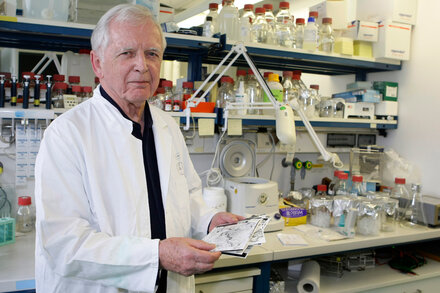

Harald zur Hausen, the Nobel laureate who discovered the connection between the human papillomavirus (HPV) and cervical cancer, has passed away at the age of 87. His death on June 9, 2023, marks the end of a remarkable journey that spanned decades of tireless research, endless criticism, and ultimately, a groundbreaking discovery that has saved countless lives.
When zur Hausen first proposed the link between HPV and cervical cancer, he was met with skepticism and ridicule. Many experts dismissed his theory as baseless speculation, while others accused him of seeking attention or personal gain. But zur Hausen, driven by his unshakeable conviction and passion for science, refused to give up. He spent years poring over data, conducting experiments, and analyzing samples, all in the pursuit of the truth.
Despite facing numerous setbacks and obstacles, zur Hausen never lost sight of his goal. He persevered, often working long hours in his lab or traveling across the world to collaborate with other scientists and share his findings. And finally, in 1983, his hard work paid off. He published a seminal paper in the journal Lancet, which provided the first definitive evidence of the link between HPV and cervical cancer.
This discovery was a game-changer in the field of cancer research and public health. Thanks to zur Hausen’s pioneering work, scientists now know that HPV is responsible for more than 90% of all cervical cancers, as well as many other types of cancer. Moreover, his research paved the way for the development of vaccines that can prevent HPV infection and significantly reduce the risk of cervical cancer.
Zur Hausen’s contributions to science have undoubtedly saved countless lives and improved the health outcomes of millions of people worldwide. But his legacy extends far beyond his groundbreaking research. He was a role model for generations of scientists, who have been inspired by his relentless curiosity, creative thinking, and unwavering commitment to scientific inquiry.
Today, as we mourn his passing, we also celebrate his life and legacy. We honor the persistence of a visionary who refused to be silenced or deterred by doubters, critics, or obstacles. We follow in his footsteps, striving to unravel the mysteries of the universe and make the world a better place through our work. And we remember that, as zur Hausen once said, “science is not just a job; it’s a passion.”