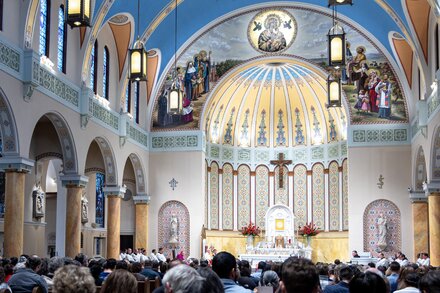

In Oklahoma, a new public school has recently opened its doors, bringing with it a wave of controversy and criticism. This new school stands on the crossroads of education and religion, blurring the boundary between church and state. It is a Catholic school, but it is also a public school. This means that it is funded by the government but will be run by the Catholic Church. This unusual arrangement has created heated debates among politicians and educators, raising concerns about the constitutionality and fairness of such a system.
The decision to allow this Catholic public school in Oklahoma is part of a wave of victories for religious conservatives. It is seen as a way to accommodate the growing demand for religious education while still maintaining the tradition of public education. However, this victory comes at a cost – the cost of delivering quality education without bias or prejudice.
Many critics argue that the Catholic public school will promote a sectarian agenda and compromise secular education. They fear that the Church will use public resources to impose its religious views on young and impressionable minds. They worry that the school will be an incubator for dogma and intolerance. Others argue that a Catholic public school promotes diversity and choice, providing an alternative to the secular public schools and empowering parents to choose the education that reflects their values.
The controversy surrounding this new school brings to mind the age-old debate of church and state. The separation between the two has been the cornerstone of democracy and religious freedom, ensuring that no single religion dominates the system. But what happens when a religious school becomes a public school? What happens when the state finances a religious institution? The answers to these questions are unclear, and the stakes are high.
As the Catholic public school in Oklahoma begins its first year, it will be closely watched by educators, politicians, and citizens alike. Its success or failure will be a litmus test for the feasibility of such a system. For advocates of religious education, it is a step forward in their crusade for faith-based education. For opponents, it is a slippery slope towards religious indoctrination. The only thing that is certain is that the school’s fate and the future of education in Oklahoma will be shaped by this bold experiment.
In conclusion, the case of the Catholic public school in Oklahoma is a fascinating one. It raises challenging questions about education, religion, and democracy. The controversy surrounding it reflects the deep divide in American society between those who believe in the separation of church and state and those who want to see more religious influence in public life. Whatever the outcome, one thing is sure – this battle will continue for a long time to come.